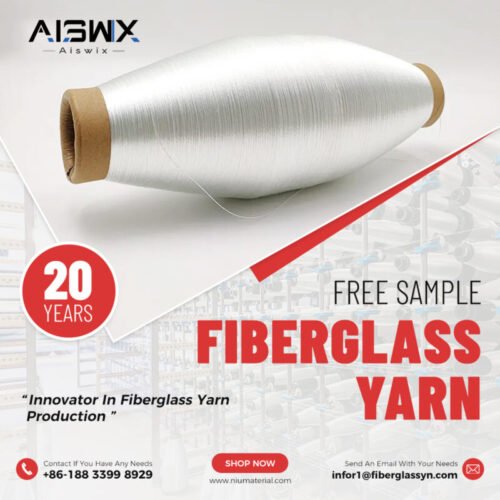
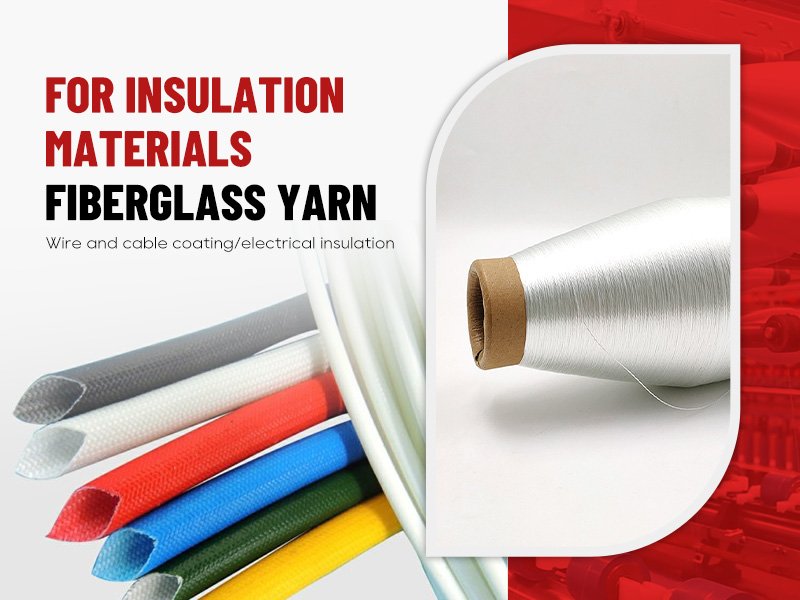
As a professional fiberglass yarn manufacturer and supplier, we serve wire and cable manufacturers, insulation producers, mesh and fabric weavers, electronic cloth makers, and non-woven producers. Fiberglass yarn is widely used in cable wrapping, braided sleeving, motor and transformer insulation, fiberglass mesh, electronic cloth, and construction non-woven.
Choosing fiberglass yarn is not simply about finding a suitable bobbin. Tex, filament diameter, twist, strand construction, sizing, and package form all affect how the yarn performs on the loom, the braiding machine, or the insulation line — and the right specification keeps production stable while keeping costs under control.
What matters is not the yarn itself, but what happens after it leaves the package — how evenly it weaves, how reliably it insulates, and how consistent it stays across repeated orders.
Why the Right Fiberglass Yarn Decides the Finished Product
Fiberglass yarnis made by drawing molten glass into fine continuous filaments and twisting them into a uniform thread. Because the yarn becomes the load-bearing or insulating element inside the finished product, its properties set the ceiling for the whole system. Uniform tex and twist weave into even openings and stable strength; inconsistent filament distribution shows up later as weak points, uneven coating pick-up, or unstable electrical behaviour.
Compared with heavier reinforcement materials, fiberglass yarn adds strength, heat resistance, and electrical insulation at very low weight, and it stays dimensionally stable against heat, moisture, and chemicals. The key is matching the yarn to the process: a lower-tex yarn suits fine cloth and thin insulation, while a higher-tex yarn fits mesh weaving, braiding, and heavier reinforcement.
One Fiberglass Yarn Doesn't Fit Every Downstream Process
Yarn wraps and braids the outer layer of wires and cables, providing insulation, heat resistance, and mechanical protection. Tex, filament diameter, twist, and sizing matter here, because the yarn must run on high-speed machines without fraying or breaking.
Electrical Insulation for Motors, Transformers and Windings
Yarn is also built into insulation for motors, transformers, generators, and windings, protecting conductors from heat, electrical stress, and moisture. Stable electrical performance, heat resistance, and consistent tex come first — uneven yarn means an uneven insulation layer.
Fiberglass Mesh and Woven Fabric
Fiberglass mesh and woven fabrics are both made from this yarn. Consistent tex and twist keep mesh openings even, coating level stable, and fabric strength predictable.
Electronic Cloth
For electronic cloth used in copper-clad laminate and PCB, the yarn must meet the highest standard. Electronic-grade yarn is drawn from very fine filaments, and small variations in filament diameter, tex, or twist can affect resin impregnation, cloth thickness, and board performance.
Construction Non-woven
In non-woven lines, yarn is opened, laid, and bonded automatically, so the package form matters as much as the yarn itself. Machine-fed lines often specify strand construction — for example double-end packages that draw two ends at once. Single-end yarn still works, but takes more manual handling time.
Choose the Right Tex, Filament Diameter, and Twist
Tex, filament diameter, and twist are the most important specifications when buying fiberglass yarn — they work together to determine weight, strength, surface character, and line behaviour.
Our fiberglass yarn is available in common tex options including 68 tex / 134 tex / 136 tex, with other specifications and adjustable filament diameter and twist available according to application and customer requirements.
Higher tex is not automatically better. The correct specification should follow the actual downstream process rather than simply choosing the largest or the finest yarn.
Consistent Fiberglass Yarn Quality Matters for Every Bulk Order
Fiberglass yarn is often bought in bulk — full pallets or containers — so consistency matters as much as the initial specification. Beyond a compliant first order, long-term buyers need the same values to hold across repeat orders: any drift in tex, twist, filament diameter, sizing content, or package weight shows up as broken ends, uneven cloth, or rejected batches.
Stable tex, twist, filament diameter, sizing, package form, and overall production quality keep your own processes predictable, batch after batch.
The Right Fiberglass Yarn Makes a Difference
Fiberglass yarn is a key base material for cable wrapping, electrical insulation, mesh and woven fabric, electronic cloth, and construction non-woven — but each process needs a different level of fineness, strength, and consistency. Lower-tex yarn suits fine electronic cloth and thin insulation; higher-tex yarn with greater tensile strength suits mesh weaving and heavier braiding. For weavers and manufacturers, product consistency and reliable supply matterjust as much.
YUNIU Fiberglass provides fiberglass yarn in different tex options, with customized solutions for specific applications and purchasing requirements. Send us your required tex, filament diameter, twist, strand construction, application, and estimated quantity — our team can recommend a suitable specification for your project.
Nicole
If you have any questions
Please contact us for free consultation and product quotation
Newsletter
Subscribe to our Newsletter & Event right now to be updated.
We noticed that you are interested in our fiberglass, but may need more information to make a decision. You can fill in the following form to get our professional consulting services.
Contact Us
We noticed that you are interested in our fiberglass, but may need more information to make a decision. You can fill in the following form to get our professional consulting services.